
Online music composition lessons
Melody, harmony, form and notation — taught as a subject in its own right, online, one-to-one, for students across the USA. You bring an idea; I teach you how to finish it.
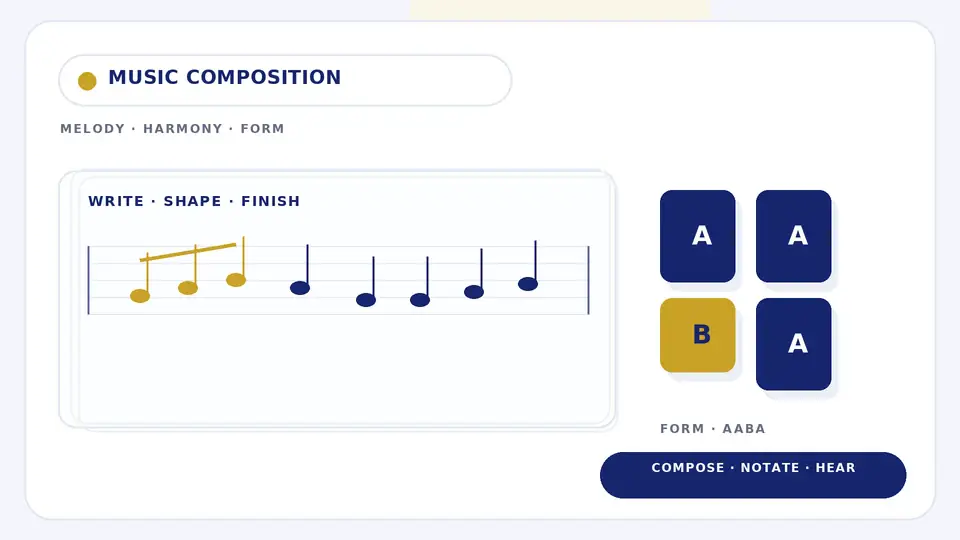
Playing other people's music teaches you the language. Composition is where you start speaking it. Most students arrive able to play a good deal and unable to write four bars they are happy with — not because they lack talent, but because nobody ever taught them the craft in sequence.
That sequence is what these lessons are. We start with a phrase: something short that you can sing, that has a shape rather than a collection of notes. Then the chords underneath it, chosen because they do something to the melody rather than because they fit. Then the larger form — how the idea repeats, how it changes, where it comes back. By the end you have a piece, written down, that you can play or hand to someone else.
I have composed for as long as I have taught, across western and Indian traditions, and I teach the craft directly rather than hoping it rubs off during instrument practice.
What you learn in composition lessons
This is the shape of the work, not a fixed syllabus. We go at the speed of the piece you are writing, and every step ends with something you can hear.
Motifs and phrases
A short idea with a shape: rise, fall, repeat. Everything else grows from here.
Melody writing
Contour, tension and release, and how to make a tune singable rather than merely correct.
Harmony under the melody
Chords chosen for what they do — triads, sevenths, inversions and simple chromatic movement.
Form and structure
Verse and chorus, AABA, strophic and through-composed shapes — how a piece holds together over three minutes.
Notation and the score
Getting it out of your head and onto the page: rhythm written accurately, parts laid out clearly.
Setting words to music
Stress, syllable and line, and why a good lyric needs the melody to get out of its way.
Arranging your own material
Which instrument carries what, and how to thin or thicken a texture for the players you have.
Raga-based composition, if you want it
Writing within a raga and a tala — a parallel framework with its own rules for development.
What you need
Whatever instrument you play, a notebook, and a way to record a rough idea — a phone is enough. Notation software helps later; it is not needed to start, and I will tell you when it is worth the money.
What is not taught
Music production — recording, mixing, mastering and DAW beat-making — and arrangement work for other artists are outside what I teach. Composition, notation and arranging your own material are what these lessons cover.
Composition across the traditions
The craft is general; the idiom is yours. Students write in whatever language they actually listen to.
Composition sits alongside the instruments rather than under them: if you also study piano, guitar or singing with me, the two feed each other. If you only want to write, that is a complete plan on its own.
Composition questions
No. Composition is what I teach: melody, harmony, form, notation and score writing, and arranging your own material for the instrument you play. Music production — recording, mixing, mastering and beat-making software — and arrangement work for other artists are outside what I teach. Better to say so now than sell half a course.
Yes, and most students do. We begin with a two-bar idea and build outward: a phrase you can sing, chords that support it, then a shape that repeats and returns. Nothing is expected on day one except an idea, even a bad one. Composition is a craft of small steps, and the free session shows where you are.
No. Plenty of songwriters work entirely by ear, and we can start there. That said, notation lets you keep what you write, hand it to another player and hear it as you imagined it. I teach it as a practical skill, not an exam subject, so you learn it when a piece of yours needs writing down.
Either way works. Some students take composition as its own monthly plan and write while they play; others add it alongside guitar, piano or singing lessons. Composition is a separate subject here, not a branch of the western instrument list, so you can book it whether or not you study an instrument with me.
The same monthly plans as every other subject: $48 for 4 one-to-one classes a month, $86.40 for 8 (10% off) or $122.40 for 12 (15% off), each 45 to 60 minutes. Before you pay, there is one free one-to-one introductory session of 15 to 30 minutes, with no obligation to continue.
Students who write often study
Try a composition lesson before you pay anything
Start with a free one-to-one introductory session (15–30 minutes) — monthly plans after that, with $48 for 4, $86.40 for 8 (10% off) or $122.40 for 12 (15% off). Month-to-month plans, and nothing to buy before we talk.