
ESA and Charter Funds for Online Music Lessons in the USA
Many US homeschool families pay for enrichment with state education funds. Whether those funds can cover online music lessons depends on your state, your program and its vendor rules — here is how to check before you book.
By Dr Banerjee ·

If you have been searching for ESA charter funds online music lessons USA options, your real question is probably simple: can the money in my child's education account pay for weekly music lessons? For some families, in some states, the answer is yes. For others it is no, and the difference is never the music — it is the rulebook of the program your family is enrolled in. This guide explains how these funds usually work, why the answer changes from state to state, and what to confirm in writing before you book a single lesson.
What people mean by ESA and charter funds
ESA stands for education savings account. In states that offer one, the state places education funds into an account that parents direct toward approved learning expenses, which can include tutoring, curriculum, therapies and, in some programs, enrichment such as music. Charter school families meet a cousin of the same idea: many charter and homeschool-charter programs give families an enrichment budget to spend with approved vendors on things like art, sports and music lessons.
The names, the amounts and the expense lists are set by each program, not by the teacher. Music is treated as enrichment almost everywhere, which means it is often allowed — but "often" is not a promise about your account.
Education Savings Account programs let families direct state-allocated education money towards approved services, which in many states can include music instruction. Charter school funds work differently: the school holds the money and reimburses or pays approved vendors directly. The two are often referred to together, and they have different rules.
Neither is a national scheme. Each state sets its own eligibility, its own list of allowable expenses and its own process for approving a provider, which is why the same family situation can be fully fundable in one state and entirely ineligible in the neighbouring one.
Why the answer changes from state to state
These programs are run state by state, and two families in different states can get opposite answers about the same lessons. One program pays approved vendors directly. Another reimburses parents after they submit receipts. A third allows music instruction but only from vendors on its own list. Eligibility can also depend on whether your child is enrolled full-time in a public program, part-time, or homeschooled independently.

That is why the only reliable sources are your state education department's pages and your own program handbook. Read the sections on eligible expenses, approved vendors and reimbursement before you rely on the funds, because those three sections decide almost everything.
State legislatures amend these programs almost every year, and the practical detail — whether instruction must be delivered by a certified teacher, whether the provider must be an approved vendor, whether funds can pay for a private studio rather than a school — changes with them. Advice from two years ago is often simply wrong now.
Arizona, Florida, Utah and several other states have relatively broad programs; others restrict music to school-run instruction or exclude it. Check the state's own program website for the current school year, not a blog summary, and check again before each new term.
Four checks to run before you count on the funds
First, is private music instruction an eligible expense in your program, or is it limited to certain categories? Second, must the teacher or studio be an approved vendor, and is there an application the studio would need to complete? Third, how does money move — does the program pay the vendor directly, or do you pay first and claim reimbursement? Fourth, what paperwork will you need to keep: invoices, proof of attendance, receipts?
Write the answers down. If the handbook is unclear, ask your program administrator directly and keep the reply. A five-minute email now is cheaper than a rejected reimbursement later.
Keep your own file as you go: the handbook pages you relied on, the administrator's reply, invoices and proof of attendance. Programs audit accounts, and reimbursement claims run far more smoothly when the paper trail already exists. This habit also protects you at renewal time, when programs sometimes ask families to show how funds were used during the year. None of this paperwork replaces the music, but it keeps the funding side boring — which is exactly where you want it.
First, is music instruction an allowable expense in your state's program this year? Second, must the provider be on an approved vendor list, and is the studio you are considering on it? Third, what documentation does the state require — invoices, progress reports, attendance records? Fourth, what is the reimbursement timeline, and can you carry the cost in the meantime?
The fourth question decides more plans than the first three. Many programs reimburse families after the fact rather than paying providers directly, which means a family may need to fund two or three months of lessons before the money arrives.
What to confirm with any studio, including us
Whichever teacher you choose, ask plainly whether they work with ESA or charter programs and what written confirmation they provide for payments. Do not assume a studio accepts these funds because it teaches homeschoolers, and do not assume it cannot help until you have asked.
We will be equally plain: whether your ESA or charter funds can pay for lessons with Dr Banerjee Music depends on your program's vendor and payment rules, and we do not want you to guess. Message us on WhatsApp at +91 62800 75157 or email drbnrj@gmail.com before enrolling, tell us your state and the name of your program, and we will confirm the payment options with you in writing. If your program pays approved vendors directly and we are not set up as one, we will tell you that honestly rather than let you find out from a rejected claim.
Ask whether the studio has an approved-vendor status or an EIN ready for invoicing, whether it can issue the itemised invoices the state requires, and who writes any progress documentation. Ask, too, what happens if a claim is rejected after the lessons have been taught.
We teach one-to-one online and can supply itemised monthly invoices and written progress notes. We are not able to guarantee that any particular state program will approve a claim, and we would rather say that plainly than have a family budget around an assumption.
If the funds work, how lessons run
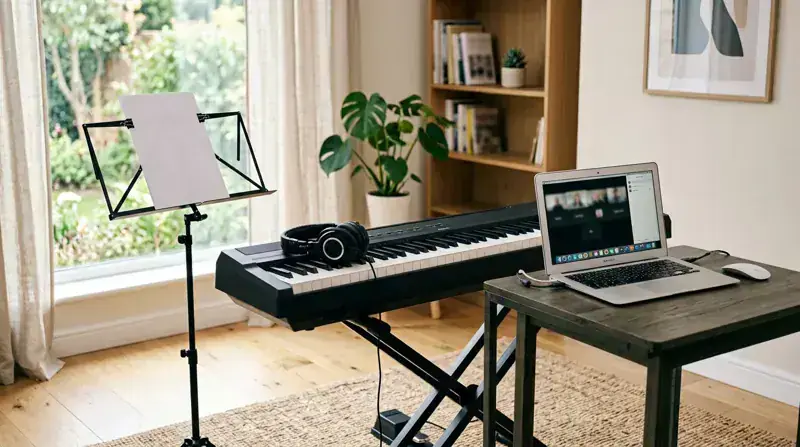
Lessons with Dr Banerjee are live and one-to-one over video, for children and adults, across piano and keyboard, singing, guitar, harmonium and Indian classical vocal. Your first step is a free introductory session of 15 to 30 minutes, one-to-one, before any enrollment or payment — use it to meet the teacher and talk through your funding paperwork at the same time.
After that, monthly one-to-one plans are $48 for 4 classes, $86.40 for 8 classes or $122.40 for 12 classes, with each class lasting 45 minutes to one hour. Group classes are $64 for 8 classes per student. Lesson times are agreed together, subject to available slots. You can see the full details on our fees page, read about the free introductory session, or contact us to start the funding conversation.
Exactly as a normal enrollment: a weekly one-to-one slot, a plan, practice notes and a written summary each month that satisfies most documentation requirements. The funding source does not change the teaching, only the paperwork, and the paperwork is easier when the studio issues the document rather than the family assembling it.
Keep every invoice and every confirmation in one folder. When a program asks for evidence, a tidy folder is the difference between a straightforward review and a month of correspondence.
Keep the program answer in writing before budgeting
Program rules can differ by state and account, so do not count on a music expense until the administrator confirms its status for your specific plan. Save the date and wording of any answer. A directory listing or a teacher’s description cannot replace the program’s own current guidance.
- Use the official program contact or account portal.
- Ask about the specific type of lesson and payment arrangement.
- Save the written reply and the program year it covers.
Ask the program administrator, in writing, whether one-to-one online music lessons from a private studio are an allowable expense for your student in this school year. Keep the reply, along with the name and date of the person who gave it. Program rules are interpreted by people, and a written answer is the thing you can point to later.
Do not budget against a phone call. If the answer has to be given verbally, follow it up with an email that summarizes what you were told and ask for confirmation. This is not distrust; it is how the program's own records are made.
Prepare a backup plan if an expense is not approved
A family can keep musical learning plans separate from an uncertain funding decision. Compare ordinary monthly options, wait for written guidance, or ask what documentation is needed before making a commitment. Do not submit private account details to a teacher or assume reimbursement will happen later.
- Confirm the program’s process before paying.
- Review the published lesson fees as a separate option.
- Keep funding questions with the program administrator, not an informal assumption.
Related: lessons for children, the fees in full and group classes.
Frequently asked questions
Are music lessons covered by every ESA or charter program?
No single answer applies to every state, account, or program year. Eligibility and payment rules are set by the program administrator. Ask that administrator about your specific account and lesson arrangement, and wait for clear written guidance before including the expense in a household budget.
What should I ask the program administrator?
Describe the lesson format, provider, and payment method accurately, then ask whether that specific expense is allowed and what documents are required. Keep the response with the account records. A teacher or directory cannot guarantee approval, and program rules can change over time.
Does this site promise to accept ESA or charter funds?
No. Families should confirm program rules directly with the administrator before making a decision. The site’s lesson information and monthly fees are separate from any account’s eligibility process; no funding method should be assumed or treated as approved without written confirmation.
Next step
Confirm any funding question with the program administrator before budgeting. Separately, the current lesson options are listed on the fees page, and a student can use the free introductory session to talk through musical goals.