
Can you really learn Indian classical music online?
Indian classical music has been taught by ear for centuries. That is exactly why it survives a video call better than almost any other kind of music lesson.
By Dr Banerjee ·
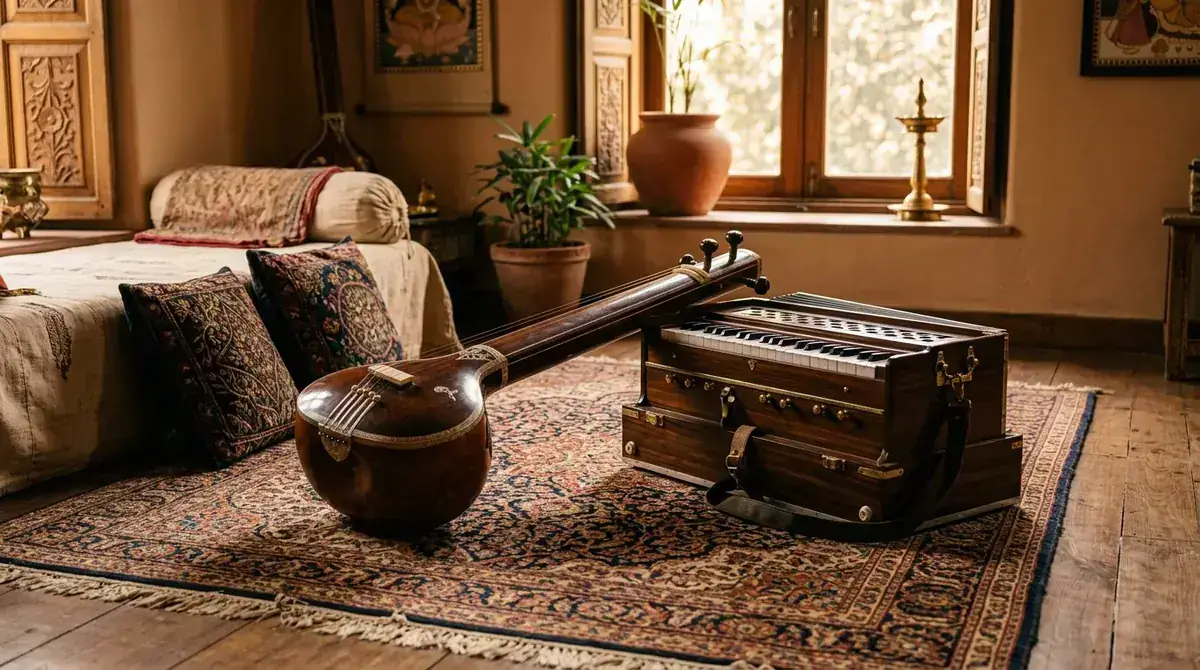
How the tradition actually teaches
Indian classical music has never depended on a textbook. It is taught the way it has always been taught: the teacher sings a phrase, the student sings it back, the teacher corrects the detail, the student tries again. It is a call-and-response method, and the ear is the instrument that matters most.
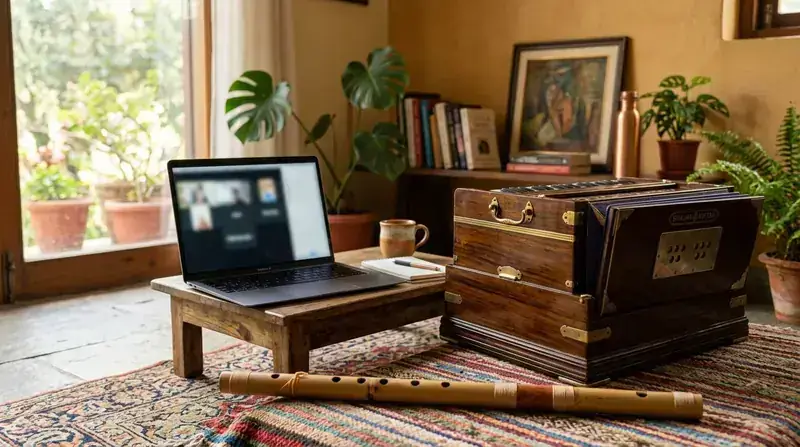
The method is demonstration and imitation, in small pieces, under a drone. A teacher sings a phrase; the student sings it back; the teacher corrects the intonation, the placement of the note in the throat, and the breath. Nothing is written down at first, which is not laziness but the point: the ear is the instrument's owner, and notation is a record made afterwards.
Lessons are also cumulative in a way that Western instrumental teaching often is not. A phrase learned in week three will still be part of the daily practice in month six, faster and more ornamented. Students who expect each lesson to bring new material find this frustrating for a month and then find it reassuring, because nothing is ever dropped.
Why that survives a video call
Because nothing in that loop requires physical contact. It requires hearing accurately and correcting precisely. Both work over a decent connection. What does not transfer well is anything where a teacher needs to physically adjust you — moving a hand, adjusting posture by touch. Indian classical vocal needs none of that.
Everything essential in the early stages is sound and repetition, and both travel down a video call perfectly well. What does not travel is physical manipulation — a teacher cannot press your ribs to show support — so the correction has to come through language and demonstration. In practice this produces students who understand their own voice better, because they were never allowed to rely on being moved into place.
Recording the lesson is the substitute for being in the room: you can sing along with the teacher's demonstration all week, at the correct pitch and tempo, which is closer to the traditional experience than a weekly in-person lesson without a recording.
What you do need
A connection good enough that pitch survives it, and a tanpura drone. A free tanpura app on your phone is genuinely enough to start. It is also worth having a quiet room, because half of the training is learning to hear yourself.
A tanpura or drone app that can hold a steady Sa, a pair of wired headphones so the drone does not feed back into the microphone, and a room where you can sing at full volume. Add a notebook and a pencil. That is the whole list, and it costs less than a month of lessons.
A harmonium or keyboard is useful but not required at the start, and it is better to buy one after two or three lessons than before. The teacher will tell you the range you are working in, and buying an instrument tuned to a different reference point is a common and avoidable expense.
What to watch out for
Latency. If there is a delay on the line, call-and-response breaks down, because you cannot sing against a teacher you are hearing late. If the delay is bad, say so in the first lesson and we will sort it — sometimes a wired connection instead of wifi is the entire fix.
Two things. The first is a teacher who promises a raga a week; ragas take months, and the promise is a sales technique rather than a curriculum. The second is a student who practices only during the lesson, which produces a pleasant weekly hour and no change in the voice.
A milder warning: be wary of any method that skips the drone, because without a reference pitch the ear learns to tolerate drift. It is the single cheapest piece of equipment and the single most useful, and a teacher who treats it as optional is telling you where their priorities lie.
Hindustani or Carnatic?
Two complete systems, not two levels. Hindustani is the North Indian tradition and tends toward slower, expansive raga development. Carnatic is the South Indian one, more composition-heavy, with an exceptionally developed rhythmic framework. Choose the one whose music you already listen to — you will practice more.
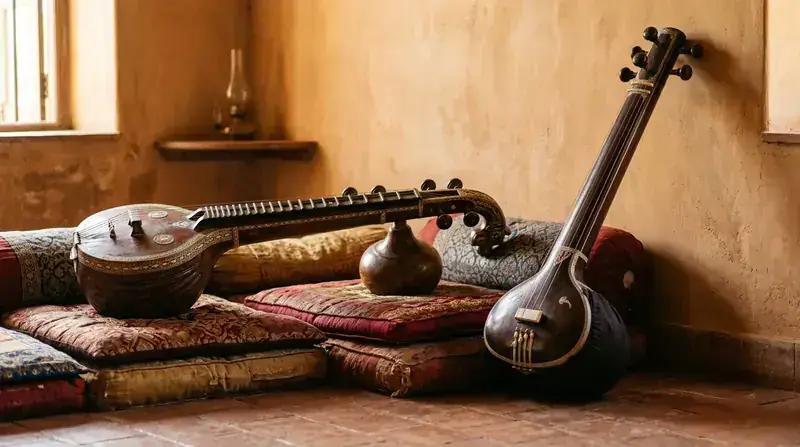
Hindustani is the tradition of North India, Pakistan and Bangladesh: a slower, more exploratory unfolding of a raga, with the voice at the center and instruments like the sitar and sarod following the same grammar. Carnatic is the South Indian tradition, more composition-driven, with a fixed repertoire of kritis, a more rhythmic emphasis, and the veena, violin and mridangam as its core instruments.
Choose by the music you already love rather than by difficulty. Both are deep, both have excellent online teachers, and both will teach you to sing in tune against a drone. If you have no preference, listen to one alap from each tradition and follow the one you want to hear again.
Choose a teacher who demonstrates and listens carefully
A useful online lesson should include clear examples and time for the student to sing or play them back. Ask how a beginner receives corrections and whether the teacher can explain terms in plain language. A directory profile alone cannot show how a lesson feels; a first conversation can help you evaluate it.
- Ask the teacher to demonstrate a short phrase.
- Try repeating it and notice whether the feedback is specific.
- Discuss the musical tradition and goals you want to explore.
In a first conversation, ask the teacher to sing a short phrase and then to tell you what they heard in your voice. A good teacher will describe something specific — where the pitch sits, whether the breath is shallow, whether the tone is forward or back — rather than saying "very good". Specific listening is the whole skill.
Ask also how they handle a student who cannot match pitch yet, and what they would give you to practice in the first week. The answers should be small, concrete and unglamorous. Grand promises about which ragas you will perform are a warning, not a selling point.
Keep a listening notebook for phrases and questions
A notebook can capture a phrase, a term, or a musical detail you want to revisit. Write down what you heard rather than trying to memorize every explanation at once. Bring the notes to the next lesson; this gives teacher and student a practical starting point.
- Note the phrase or recording you listened to.
- Write one unfamiliar word and its explanation.
- Mark the moment you want to hear or try again.
Related: Indian classical vocal lessons and Hindustani vocal.
Frequently asked questions
Do I need prior music theory to start Indian classical music?
No. A beginner can start with listening, a comfortable pitch, and short call-and-response phrases. A teacher can introduce musical terms as they become useful. Bring a song or sound you enjoy and ask how the first lesson will connect it to practical listening or singing.
What is useful to have for an online vocal lesson?
A quiet space, a device with clear audio, and a comfortable place to sit or stand are helpful. If you use a drone app, keep it quiet enough to hear your own voice. Ask the teacher whether the instrument or recording setup you already have is sufficient.
How should a beginner choose between Hindustani and Carnatic music?
Listen to examples and notice which repertoire, language, or musical style interests you. The two traditions have distinct approaches, and a teacher can explain the starting point for each. A short introductory conversation can help you discuss the music you want to learn without needing prior expertise.
Next step
Bring your listening questions to the free introductory session; you can also review the current monthly plans on the fees page before deciding how to begin.