
Guitar Riffs for Teens: A Practice Plan That Works
A riff is a short musical idea you can repeat and shape. This guitar riffs practice plan for teens breaks the work into timing, a few manageable notes, and short sessions that fit a school week—without copying a famous recording note for note.
By Dr Banerjee ·
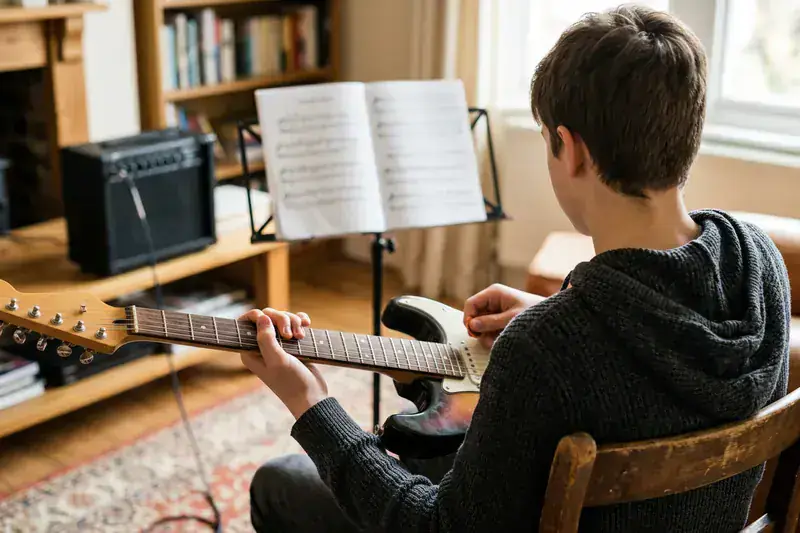
What a riff is, and why it is a good first goal
A riff is a compact musical phrase that returns or anchors a song. For practice, you do not need to learn a long solo: choose a small, original pattern of two or three notes, or use a teacher-approved exercise. Keep the phrase short enough to repeat without losing your place.
Start with relaxed hands and clean notes. If a string buzzes, slow down and check where each fingertip lands rather than pressing harder. A clear sound at an easy tempo is a better starting point than speed.

A riff is short enough to hear as one idea and repeat without losing your place, which is why it works so well as a first target for a teenager. It usually has one rhythmic hook and a small number of notes, so you can tell within a week whether you are playing it right.
The goal is not to copy a recording exactly. Learn the shape and the timing, then make it your own — change the ending, play it clean instead of distorted, slow it down. A riff you can play at your own tempo is worth more than one you almost play at the record's tempo.
Timing first: practice with a metronome
Set a metronome to a comfortable, slow pulse and tap your foot or count before playing. Try one note on each click, then leave a beat of space and listen for whether the next note arrives evenly. The click is a guide, not a race.
Once the pulse feels steady, play the short riff at the same tempo for several clean repetitions. Increase speed only in small steps and return to the slower setting if the timing gets uneven.
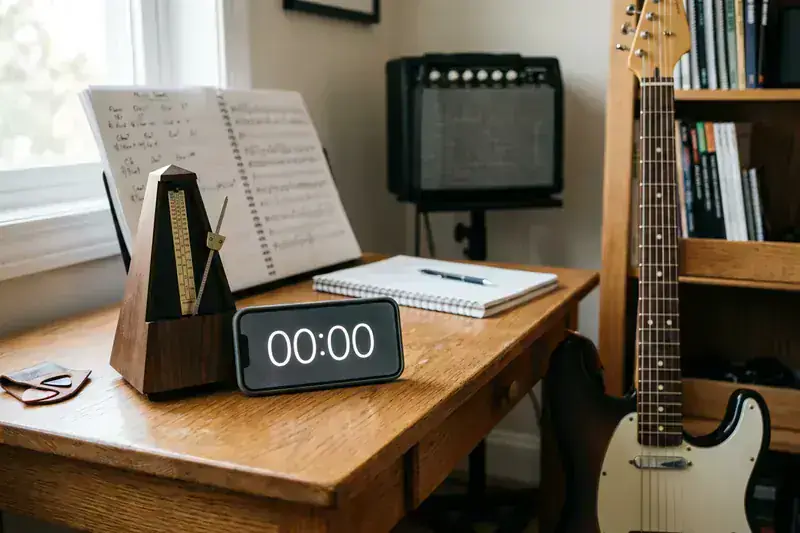
Set the metronome to half the speed of the recording and play the riff with the click on every beat. When that feels easy, put the click on beats two and four, which is how a drummer would count it and how the riff will feel in a band. Most students find this harder than it sounds and much more useful than playing faster.
Do not increase the tempo until you can play the riff four times in a row without stopping. Speed without a clean repetition is just noise at a higher pitch, and it is the habit that makes teenage guitarists sound rushed at auditions.
Build the riff in four short parts
Break the phrase into four jobs: fret the first shape, move to the next note, release extra pressure when changing strings, and join the pieces. Practice each change slowly, then connect two parts at a time. This makes it easier to find the movement that needs attention.
Use a light touch with the fretting hand and keep unused strings quiet with relaxed muting. Do not copy a copyrighted riff note-for-note; make a new pattern or work from a lesson exercise instead.
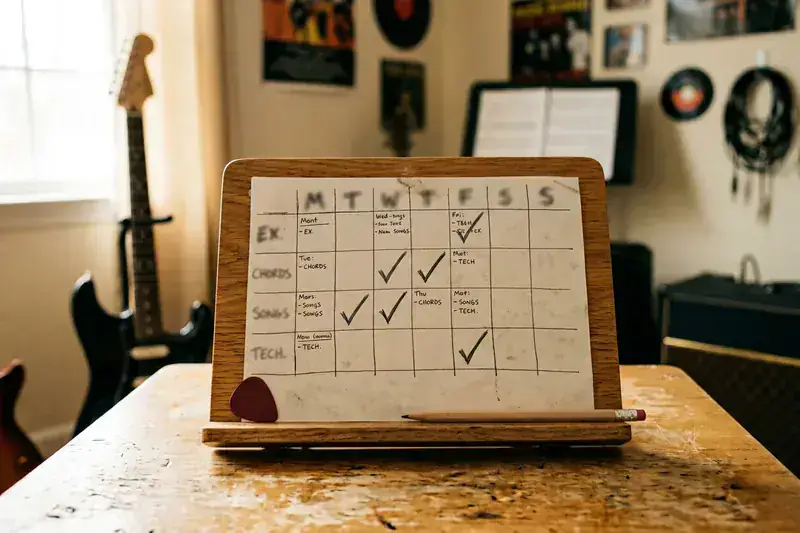
Split the riff into its four natural chunks — usually one bar each, or one hand movement each — and loop the first chunk ten times, then the second, then join them. The join is where mistakes live, so practice the join on its own: last note of chunk one into first note of chunk two, slowly, and nowhere else.
Keep a tally of how many clean repetitions you get. Four clean in a row is the point at which you move on. If you get three and then a mistake, start the count again, because the fourth repetition is the one that teaches your hands to finish.
A weekly plan: 20 minutes, four days
On four days of the week, try a 20-minute session: three minutes to settle in and tune, five minutes on a slow pulse, seven minutes on one short phrase, and five minutes to play it cleanly and jot down what to repeat. Take a short pause if your hands feel tired.
On the other days, listen to your own short recording or rest. A day away from the guitar can be part of a steady routine; you do not need a long practice marathon to make progress.
Day one: the riff slowly with the metronome. Day two: the joins, and the two bars that keep going wrong. Day three: play along with the recording at reduced speed. Day four: play it from memory, recorded, and listen back once. That is eighty minutes a week and it is enough to learn a riff properly.
Record on the last day, every week, with the same phone in the same place. Four recordings later you will hear the improvement that you cannot feel day to day, and that is what keeps a teenager practicing through the weeks when it feels stuck.
Tone and muting basics
Choose a clean, comfortable volume and listen for each note’s start and end. Muting means gently quieting strings you do not intend to hear; it should not require a clenched hand. Try one string at a time, then check whether the rest of the guitar stays quiet when you move.
If your shoulder, wrist, or fingers hurt, stop and reset your posture. Ask a parent or teacher to check the instrument position rather than pushing through discomfort.
Most of what sounds wrong in a beginner's riff is not the fretting hand — it is the strings ringing when they should be silent. Rest the edge of your picking hand lightly on the lower strings, and use the fretting fingers to damp the strings you are not playing. Practice the mute on its own: strum, then stop the sound dead.
Set the amp's gain lower than you want and its volume higher. A riff played clean sounds like a riff; a riff played with too much distortion hides timing mistakes and teaches bad habits that are difficult to remove later.
Parents and booking
For a student under 18, I contact a parent or guardian before a lesson is booked. No enrollment or class goes ahead until a parent or guardian has agreed to these terms and confirmed in writing.
A parent or guardian can help set a practice window, ask about the lesson format, and check that the instrument is comfortable. If you want help checking a prospective teacher’s background, the Music Teachers National Association Find-a-Teacher directory is one place to start learning about music-teacher resources. Membership or a directory listing is not a guarantee of fit; ask your own questions before choosing.
Lessons are one-to-one and online, in a weekly slot, with practice notes after each session so you know what the week's task is. A parent does not need to sit in, although for the first lesson it often helps to check the camera angle and the volume.
If you are unsure whether the style is a fit, the free 15 to 30 minute introductory session is where to find out. Bring a riff you are working on, even if it is rough — that is much more useful than a polished piece you have already mastered.
Next steps
Choose one short phrase, set a slow pulse, and write down the tempo that stays clean. Review the lesson fees, send questions through the contact page, or read the guide to online guitar lessons for kids. A free introductory session can help a family discuss goals and setup before choosing a plan.