
Adult Piano Lessons Online in the USA: A Beginner Plan
A beginner-friendly plan for adults who want to start piano at home while balancing work, family and other commitments.
By Dr Banerjee ·
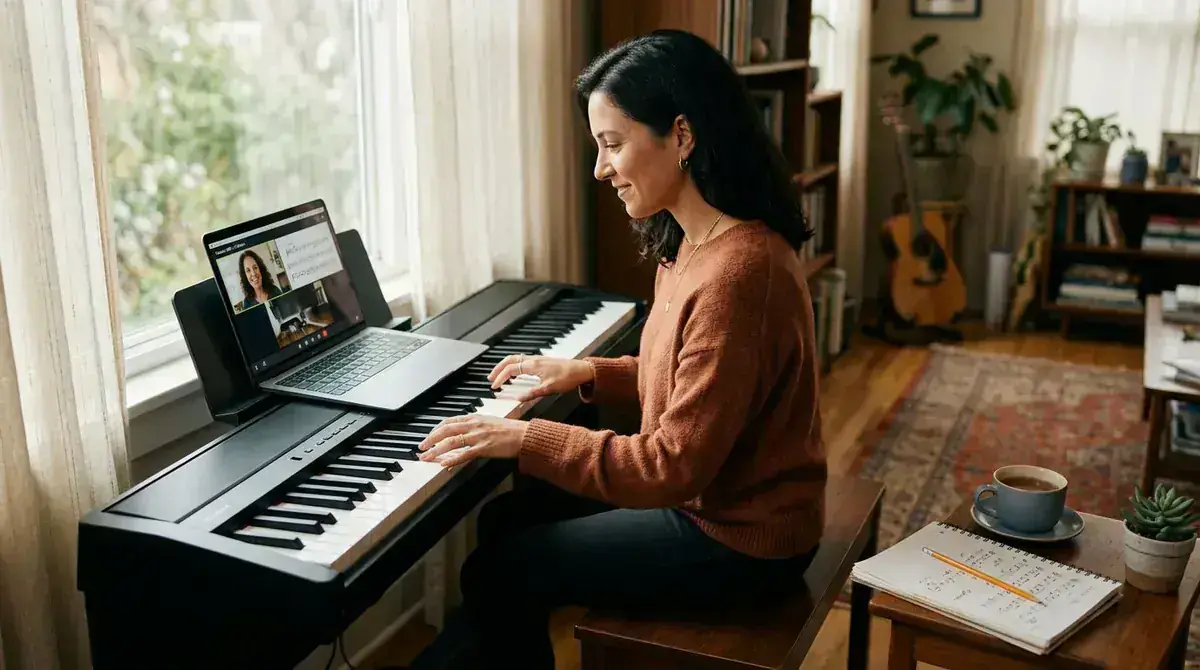
Pick a goal that fits your reason for starting
Adult piano lessons online in the USA can start with a song, a style or a practical skill the student wants to build. Some beginners want to read notation; others want to accompany singing or return to music after a long break. Naming the goal helps a teacher choose useful first exercises.
You do not have to decide on a complete repertoire before the first lesson. Bring a song you enjoy or describe what you want to be able to do. The teacher can help turn that interest into a small first step.
Be concrete about it. "Play the accompaniment to one song I can sing" is a goal; "get better at piano" is a mood. A concrete goal lets a teacher choose the first four weeks and lets you judge at the end of them whether this is working, without needing to know anything about piano technique.
Two goals are worth having, not one: something you want to play, and something you want to understand — how chords fit together, why a piece is written the way it is. Adult students who only chase the first plateau quickly; the second keeps the instrument interesting after the first song is finished.
Set up a keyboard you can use comfortably
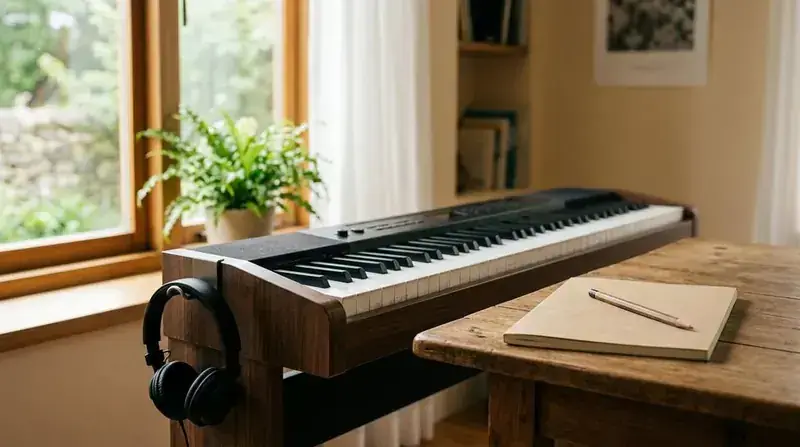
Place the keyboard on a stable stand or table at a comfortable height, and give your hands room to move. The camera should show the keys and upper body. If you are choosing an instrument, ask what features are useful for your current goal before buying.
Keep the practice area ready where possible: headphones, a pencil and the current music nearby. If you share a home, plan a time when you can play without feeling rushed. A quiet, repeatable setup matters more than decorating a dedicated studio.
Height matters more than brand. Sit so the keys are at roughly elbow height, with the bench far enough back that your forearms are level, and check that a real piano is not one you can only reach by hunching. Most adult beginners practice at a desk, which is why their wrists ache and their shoulders creep up within ten minutes.
A stand, a bench or a firm chair at the right height, and headphones you do not mind wearing for twenty minutes will do more for your first month than two hundred dollars of extra features. If the keyboard has speakers, keep them on low and use headphones for the lesson itself so the teacher hears the instrument rather than the room.
Build consistency around work and family life
An adult practice routine can be small enough to fit a regular week. Choose a few specific minutes, focus on a single musical task and stop before the session becomes frustrating. If a busy week interrupts practice, bring that information to the next lesson instead of trying to catch up all at once.
Ask how the teacher adapts practice tasks when work schedules change and whether the class pace can be discussed. Start with one free introductory session, then compare monthly plans on the fees page.
Fifteen minutes before the household wakes up is the routine that survives longest in practice, because nothing else has been scheduled over it yet. The alternative that works nearly as well is immediately after dinner, with a hard stop that everyone knows about. What rarely survives is the plan to practice "when there is time", because there is never time.
Protect the slot the way you would protect a class: it goes in the calendar and it does not move for a social invitation. Twenty minutes, four days a week, is a real amount of piano — about seventy hours a year — and it is achievable for almost any working adult.
Measure progress with one small musical target
A useful weekly goal can be a steady rhythm, a smooth two-measure transition, or a melody played without stopping. Choose a target you can hear and repeat. This makes practice concrete without comparing your pace with another adult learner.
- Write down the exact bars or phrase to revisit.
- Slow the passage enough to keep a relaxed hand shape.
- End practice by playing a familiar piece you enjoy.
Pick the target with your teacher and write the number down: the section you can play at 60 beats per minute without a mistake, the chord sequence from memory, the piece played end to end without stopping. Re-test it on the first lesson of each month. Adults are usually surprised by how much has changed, because improvement in piano is invisible from inside the practice room.
When a target stalls for three weeks, do not add practice time; change the target's size. Nine times out of ten the passage is too long or too fast, and cutting it in half fixes it in a session.
Choose a keyboard by the features you will actually use
A beginner does not need every feature on a large instrument. Prioritize a stable stand, comfortable key action, enough keys for the music you plan to study, and a way to hear the sound without disturbing others. Ask a teacher before purchasing accessories.
- Check the available room and whether the keyboard can stay set up.
- Try the keys if possible; touch and sound matter more than decorative extras.
- Ask whether headphones or a sustain pedal will help your current repertoire.
For a beginner, the features that matter are weighted or semi-weighted keys, a sustain pedal input, and 61 to 88 keys depending on space. Sounds beyond a decent piano and strings, a screen full of menus, and built-in lesson modes are almost never used and are not worth paying for. If the keyboard will live on a desk, check its depth against the desk before ordering.
Do not upgrade until you can name what the current instrument stops you doing. The usual honest reasons are "I need more keys for this piece" and "I can hear the touch is not responding the way my teacher's does" — both of which appear around month six to twelve, not month one.
Balance a familiar song with one new skill
Adults often stay motivated when practice includes music they enjoy and one focused technical task. Spend some time on a familiar passage, then work on a small new skill from the lesson. Keeping both in the routine prevents practice from feeling like either a test or unfocused playing.
- Choose a familiar song that feels rewarding to play.
- Add one specific lesson task, such as a rhythm or hand transition.
- End by noting what to ask about next time.
Use a slow tempo to keep hands relaxed
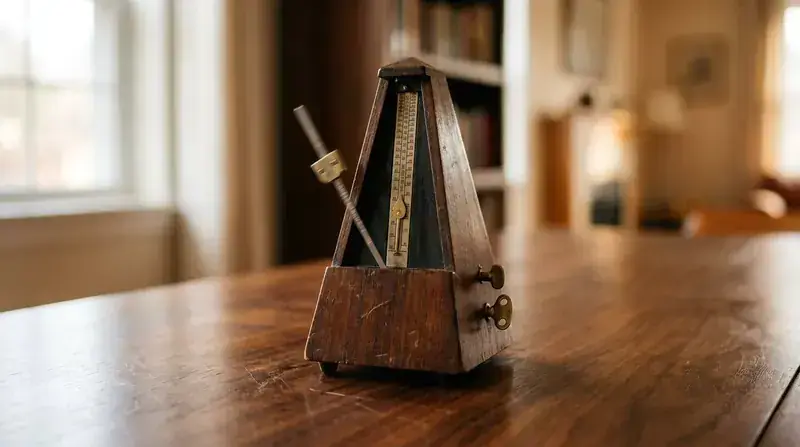
When a passage breaks down, slow it enough to play with a relaxed hand. A metronome can help if it supports the task, but it should not force speed before the notes are secure. Pause when tension appears and ask the teacher to check posture or fingering.
- Start slower than the tempo you hope to reach.
- Keep shoulders and wrists comfortable while repeating a short phrase.
- Increase speed only after the movement remains controlled.
Related: Piano and keyboard lessons and Lessons for adults.
Frequently asked questions
Am I too old to start piano lessons?
Adults can begin piano at any age. Prior experience is not required; a first conversation can focus on music you enjoy, your available practice time, and a manageable starting point. A teacher can help select a target that feels challenging but still achievable this week.
How much practice should an adult beginner do?
Start with a routine that fits your week and can be repeated without strain. A short, focused session on a specific lesson task is often more useful than an occasional long session. Keep the keyboard choice practical for your space, budget, and intended music.
Do I need an acoustic piano for online lessons?
Not always. A suitable keyboard can support beginner study if it is stable and comfortable to play. Discuss your goals and equipment with the teacher before deciding to replace or upgrade an instrument. Bring equipment questions to the introductory session before purchasing anything new.
Ready to explore lessons?
Compare the monthly fees and plans or learn what happens in the free introductory session.