
Harmonium Lessons for Beginners in the USA: First Steps
A clear starting point for US beginners who want to learn harmonium online, including setup, hand coordination and what to ask a teacher.
By Dr Banerjee ·
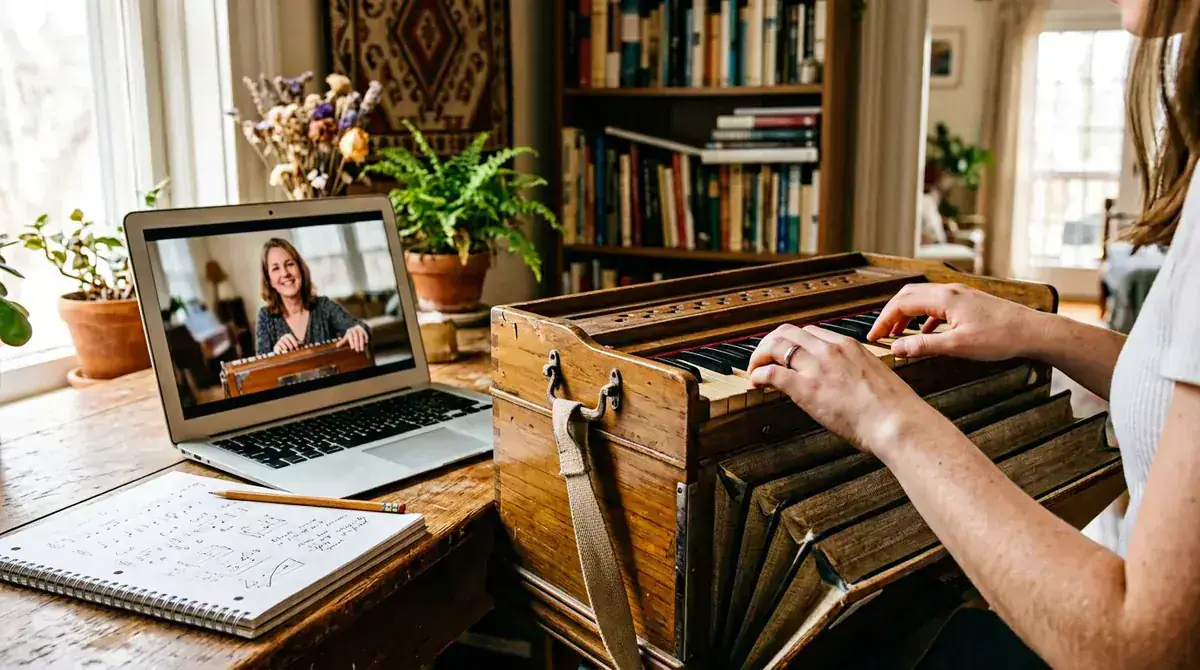
Learn the instrument’s two jobs separately
Harmonium lessons for beginners in the USA can start by separating two actions: pressing keys and moving the bellows to keep air flowing. At first, a student can explore a few comfortable notes while keeping the sound even. That coordination takes attention; there is no need to begin with a complicated song.
Sit where the instrument is stable and both hands can move without strain. A teacher can help check posture and bellows motion over video if the camera shows the hands and instrument. If the harmonium has not been purchased yet, discuss its range and practical size before choosing one.
Run the bellows at a steady pressure for a minute while playing nothing at all, then add a single held note. The sound should stay even from the first second to the last. Most beginners let the pressure sag as soon as their fingers start working, and the resulting wobble is the first thing a teacher hears.
Once a held note is steady, add two, then three. Keep the phrase short enough that the bellows do not run out mid-line: decide in advance where you will reverse the direction, and mark it on the page in pencil.
Use small patterns before full compositions
A short sequence of notes lets a beginner listen for steady pitch and even sound. Repeat it slowly, pause, and try again without forcing the bellows. The goal is to notice what changes when the hand pressure or air flow changes, not to make the instrument loud.

For learners studying Indian music, the harmonium can support pitch practice, but it does not replace listening to the voice or the musical phrase. Ask the teacher how the instrument will support the student’s particular interest, whether that is accompaniment or beginner keyboard work.
A pattern of three or four notes, played evenly, is enough for the first two weeks. Play it slowly, then with a metronome, then sing it while playing. That last step is the one that matters most in Indian music, because the instrument is usually accompanying a voice rather than standing alone.
Add one new pattern a week and keep the old ones in rotation. Beginners who accumulate twenty patterns and can play none of them cleanly move slower than beginners who have six patterns they can play without thinking.
Ask practical questions before choosing a plan
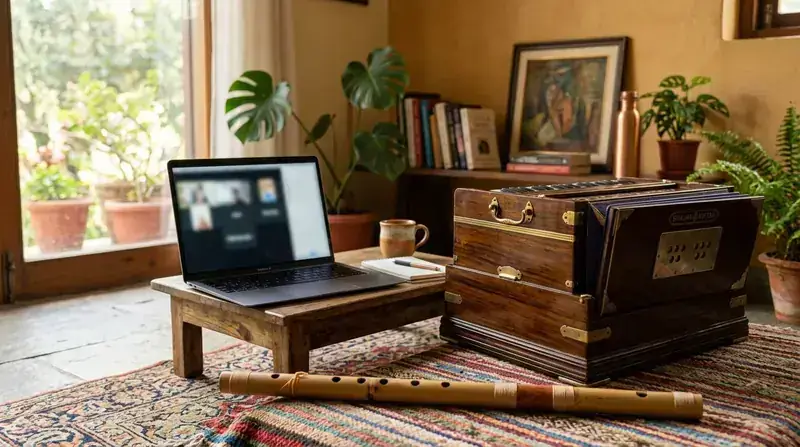
Check that the device camera can show the keyboard and bellows, and leave enough room for the teacher to hear the instrument clearly. A quiet space and a stable internet connection are helpful. An external microphone can be considered later if the sound is unclear; it is not a reason to delay a first discussion.
The introductory session is a chance to talk through the instrument, prior experience and learning goals. Review the monthly plan details on the fees page; plan prices are separate from any instrument purchase.
Ask what the teacher's own instrument is tuned to, whether they teach with a tanpura or a drone app, and how they handle the fact that the harmonium cannot bend a note the way a voice can. The answers tell you more about the lessons than the price list does.
Ask, too, what the first month would contain in terms of pieces. A teacher who can name three specific bhajans or compositions you would be playing by week four is planning; a teacher who answers in terms of "basics" is not.
Choose a starter harmonium without overbuying
A first instrument should be comfortable to open, play, and store. Before ordering, check that the bellows move smoothly, keys return freely, and the instrument can sit securely on a table. Ask what pitch range and portability suit the music you want to learn.
- Try the key action and bellows if an in-person trial is available.
- Check the return policy and shipping condition for an online purchase.
- Ask your teacher before paying extra for stops or features you may not use.
For a first instrument, a standard three-and-a-half octave harmonium with a moderate number of stops is the practical choice. Check that the bellows move smoothly and quietly, that no reed buzzes on a held note, and that the keys return without sticking. Take someone who plays, if you can, and play the same note on every stop.
Avoid instruments that are decorative but mechanically fragile, and avoid anything that has been stored somewhere damp. A harmonium that has lived in a humid room will sound fine for ten minutes and then drift.
Practice airflow and melody as separate skills
The bellows supply steady air while the fingers shape the melody. Beginners often press keys harder when the sound wavers; instead, slow down and notice whether the airflow is even. Work on a short line with a comfortable hand position, then add the words or singing only when ready.
- Use a short, easy phrase and keep the bellows movement smooth.
- Pause between attempts so the instrument and hands are not rushed.
- Record a brief practice clip for your own review and note one question for class.
Ten minutes of the session on the bellows and the fingers, with no music in front of you: hold, release, hold, at an even pressure. Then ten minutes on the phrase you are learning, with the airflow already settled. Separating them means that when the phrase goes wrong you know which of the two caused it.
As the phrase gets easier, lengthen it rather than speeding it up. The characteristic sound of a good harmonium player is long, even lines, and lines are built by breathing the bellows deliberately rather than by playing faster.
Plan a first month around small musical goals
A beginner can learn the instrument in stages: familiarizing with the keys, keeping a steady bellows motion, finding a short melody, and then joining the parts. A teacher can adjust the order to the student’s goals. Writing down one task after each lesson makes it easier to restart at home.
- Label a small section of the keyboard only if it helps orientation.
- Practice one short pattern with even airflow.
- Keep a note of the next musical step instead of adding extra exercises.
Week one: a steady held note and the first three notes of a scale. Week two: the same scale up and down with the voice joining. Week three: a short devotional or film melody, one line at a time. Week four: the same melody played while singing, at a tempo where neither collapses.
Write those four targets down and check them at the end of the month. If three of the four are done, the month went well; if none are, the plan was too ambitious or the instrument is fighting you, and both are worth saying out loud in a lesson.
Store and check the instrument between lessons
A harmonium works best when it is handled gently and kept in a stable, dry place. Before practice, check that the instrument sits securely, the bellows move freely, and the keys return. If a note sounds unusual, mention it to the teacher before trying repairs or forcing a stiff part.
- Close and store the instrument as its maker recommends.
- Keep food, drinks, and direct heat away from the keyboard.
- Describe a sound or movement problem and ask before attempting a repair.
Related: Harmonium lessons and Indian classical vocal lessons.
Frequently asked questions
Do I need a harmonium before my first lesson?
Not necessarily. Talk through your goals and the instrument options first. If you already own a harmonium, mention its size and condition; the teacher can help you plan a first lesson around what is available. A short conversation can clarify which details matter for your music, room, and budget.
Is harmonium difficult for a complete beginner?
The basic layout can be learned step by step. Coordinating bellows with keys takes practice, so a teacher can separate the tasks and start with a short melody instead of expecting both hands and airflow to feel natural immediately. The teacher can separate bellows control from melody so each part feels manageable.
Can harmonium lessons be taught online in the USA?
Yes. A video call can show hand placement, keys, and bellows while the teacher demonstrates musical examples. A stable camera angle and a quiet room help both people hear and see the instrument clearly. Good lighting and a steady device view also make online feedback more useful.
Ready to explore lessons?
Compare the monthly fees and plans or learn what happens in the free introductory session.