
Indian Classical Vocal Lessons Online: A US Beginner Guide
What a US beginner can expect from online Hindustani or Indian classical vocal study, from listening practice to a first lesson setup.
By Dr Banerjee ·
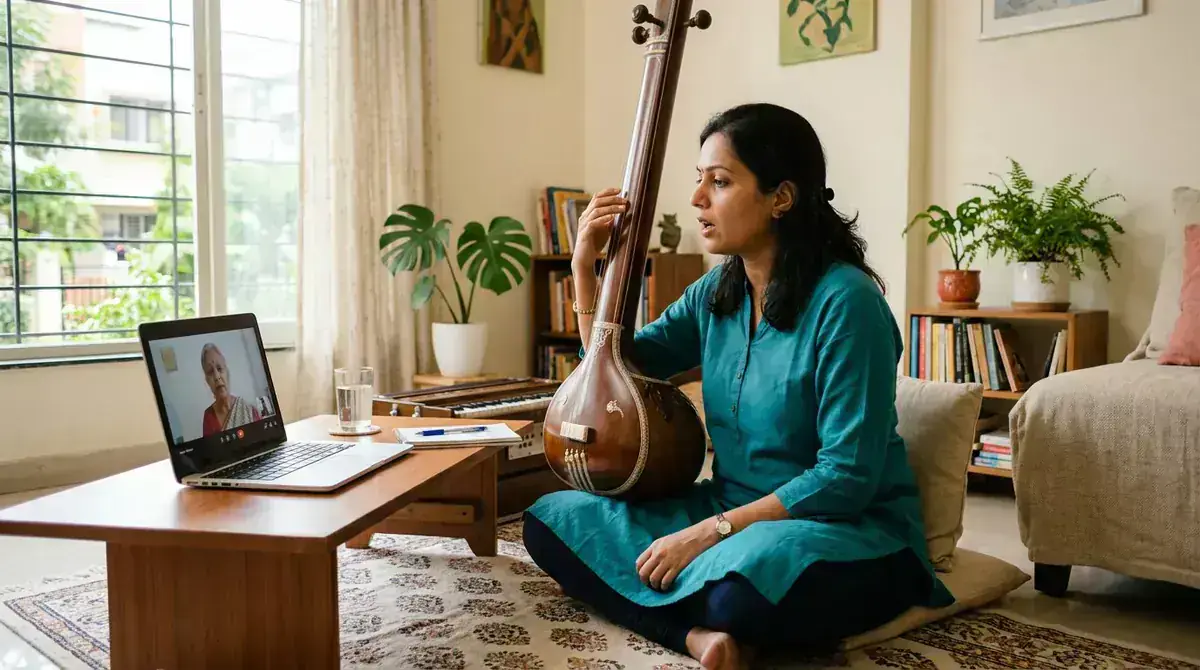
Begin with listening, not a long list of notes
Indian classical vocal lessons online often begin by helping a student hear a stable pitch and repeat a short phrase accurately. A teacher may sing a note or phrase and invite the student to echo it. The early work is about careful listening, breath and a comfortable tone, rather than racing through many exercises.

A tanpura drone or another agreed pitch reference can help the student settle into the sound. You do not need to know notation before starting; the teacher can explain the sounds and terms as they become useful.
In the first lessons the teacher sings and you copy, often on a single pitch, for longer than feels productive. That is the work: matching pitch accurately and holding it steadily, which is the skill everything else depends on. Students who rush to ragas with an unstable Sa spend years correcting the ear they skipped.
Practice this with a drone at a comfortable pitch for five minutes a day. Sing Sa, then the note above, then back, and check each one against the drone rather than against your memory of the previous note. The drone is the teacher here, and it is available every day of the week.
Prepare a quiet, repeatable lesson space
Choose a room where the student can hear both the teacher and their own voice. Place the device so the teacher can see the student’s face and posture, and keep the microphone clear of fans or music playing in the background. Headphones may help with focus, but they should not make it difficult to hear the student’s natural voice.
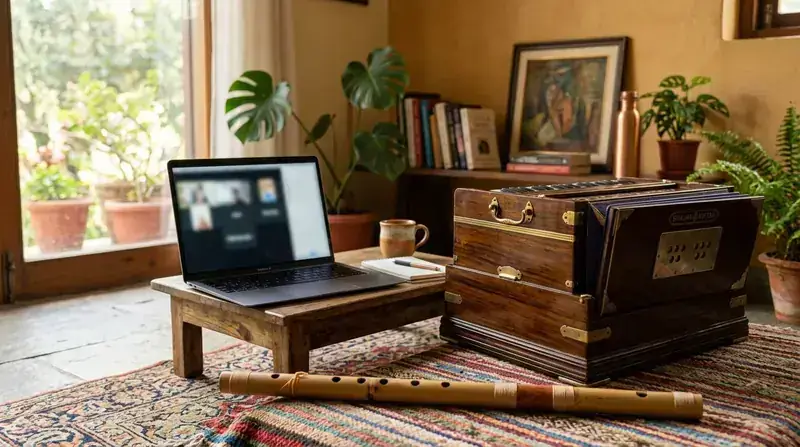
Bring water and a notebook for the small practice ideas that come up. A harmonium is useful for some learners but is not a prerequisite for the first session. Ask before buying an instrument if you are unsure what suits the student’s goals.
You need a room where you can sing at full voice without apology, a wired headset that does not pick up the drone from the speakers, and a stable connection. Put the device at eye level so the teacher can see your mouth and your breathing. A student singing quietly because the household is asleep cannot be taught breath control.
Keep the tanpura app, a notebook and a glass of water within reach. The notebook matters more than it sounds: write the phrase you are learning in your own words at the end of each lesson, because the detail that feels unforgettable at the time is gone by Thursday.
Build a practice habit without rushing repertoire
A beginner can work on a short daily listening or pitch exercise, then return to it at the next lesson. Recordings made by the student for personal practice can help them notice a phrase; follow the teacher’s and family’s rules about recording and sharing. Progress is individual, so avoid comparing one student’s timeline with someone else’s.
Ask how the teacher introduces swaras, pronunciation and repertoire, and how the practice task changes as the student becomes more comfortable. A free one-to-one introductory session can clarify fit. Monthly options are listed on the fees page.
Twenty minutes a day, five days a week, with the same opening: a drone, a long Sa, then the phrase being learned. The temptation in Indian classical music is to collect ragas; the practice that produces a voice is repetition of a small amount of material with attention to intonation.
Track one thing per month — the steadiness of Sa, the accuracy of a particular phrase, the length of a breath — and leave the rest alone. A student who can hear their own drift is progressing even when the repertoire has not grown.
Build a riyaz routine that fits an American school or work day
Consistency matters more than a long session that is hard to repeat. Choose a quiet time that already exists in the week, such as before breakfast or after work. Begin with a comfortable note, listen carefully, and stop if the voice feels strained.
- Spend a few minutes settling the breath without forcing volume.
- Repeat one short phrase slowly, then listen back for pitch and clarity.
- Write down one question to bring to the next lesson instead of trying to fix everything alone.
Split the practice if the day is full: ten minutes of pitch work before school or work, ten minutes of phrase work in the evening. Two short sessions with a gap between them are more valuable than one long one, because the second starts with an ear that has had time to settle.
Keep the routine identical in shape even when it is short. The same first note, the same drone, the same opening exercise tells the voice what is happening before the mind has to decide anything.
Check the listening setup before you sing
A clear microphone position helps a teacher hear pitch, breath, and pronunciation. Keep the device at a comfortable distance and avoid speaking directly into a headset mic. If you use a tanpura or drone app, keep its level low enough that your own voice remains easy to hear.
- Use wired headphones if wireless delay makes it hard to stay with the drone.
- Test the room once at normal singing volume, not only while speaking.
- Tell the teacher which language, song, or raga you are exploring so examples can be relevant.
Test the headphones and the microphone in the same session you will use them, and set the volume so you can hear the teacher's voice over your own. If you hear yourself delayed or doubled, the software is monitoring your own input; switch that off before the lesson rather than during it.
Have a fallback ready: a phone number and a second device, in case the video platform fails on the day. Every online teacher has this conversation eventually, and the students who prepared for it lose five minutes instead of a lesson.
Choose one phrase to study deeply
A short phrase from a song or lesson can reveal more than a long list of exercises. Listen first, sing it back comfortably, and notice where the pitch settles or moves. Keep the example in a notebook or personal recording so you can compare it at the next lesson without guessing what changed.
- Write the phrase or lyric in a notebook.
- Mark the note or turn that feels unfamiliar.
- Bring one clear question about that phrase to the next session.
Pick one phrase from the raga you are learning and stay with it for a week: sing it slowly, then in rhythm, then with the ornaments the teacher demonstrated, then from memory. Depth on one phrase teaches intonation, breath and phrasing at once, which breadth across ten phrases does not.
Record the phrase at the start and the end of the week. The difference is usually more convincing than how it felt, and it is what you take back to the lesson.
Keep the voice comfortable while building range
A beginner does not need to push for high or loud notes to make progress. Work in a range that feels easy, pause when the voice tires, and let the teacher adjust a phrase to suit the student. If a sound feels strained, stop and describe what happened rather than repeating it.
- Begin with a comfortable note, not the highest note available.
- Take a short pause between attempts.
- Ask the teacher to adapt an exercise when it feels uncomfortable.
Related: Indian classical vocal lessons and Hindustani vocal lessons.
Frequently asked questions
Can a beginner in the United States learn Indian classical vocals online?
Yes. A beginner can start with listening, breath, a comfortable pitch, and short guided phrases over video. The teacher can adapt examples to the student’s background and explain unfamiliar musical terms during lessons. Keep notes on comfortable pitch and useful examples so you can revisit them between lessons.
Do I need to know a raga before my first lesson?
No. Bring a song, artist, or musical sound you enjoy. The teacher can help identify a useful starting point and explain raga concepts gradually, without expecting prior theory knowledge. A first session can introduce these ideas gradually without assuming earlier theory study or training.
How often should I practice between vocal lessons?
Choose a manageable routine you can repeat and keep the voice comfortable. Short, attentive practice is more useful than pushing through fatigue; ask the teacher to set a specific listening or singing task for your current level. Comfort and attentive listening are better guides than a fixed practice target for every student.
Ready to explore lessons?
Compare the monthly fees and plans or learn what happens in the free introductory session.