
What is a raga? Explained without assuming you read music
Not a scale, not a melody, not a mode — a raga is closer to a set of rules for a mood, with a time of day and a season attached to them, and it is learnable.
By Dr Banerjee ·
Start with what it is not
A raga is not a scale. A scale is a list of notes you may use. A raga is a list of notes plus rules about where you go, which notes you rest on, which ones you skip on the way up but not on the way down, which phrases belong to it and which do not. Two ragas can use the same notes and be unmistakably different pieces of music.
A raga is not a scale, a mode, or a tune. A scale is a set of notes; a raga is a way of moving through a set of notes, with rules about which are strong, which are passing, which are approached from above and which are sustained. Two ragas can use exactly the same notes and be instantly distinguishable to a listener who knows them.
Nor is a raga a fixed composition. The composition is one thing you can do inside a raga; the improvised unfolding, the alap, is another and is often the larger part. Learning a raga means learning its behavior, not memorizing a piece in it.
A useful comparison
Think of a scale as a set of ingredients and a raga as a recipe — but a recipe that also specifies the time of day, the season, and what the food is supposed to make you feel. That last part is not decoration. Ragas are traditionally associated with times and moods, and the association is part of what a performer is working with.
Think of a raga as a personality rather than a vocabulary. The notes are the words available; the raga is the way this particular speaker uses them — which word they linger on, which they rush past, what they never say at the beginning of a sentence. That is why ragas are associated with particular moods and particular hours.
The comparison is imperfect but useful for the first month, because it explains why a student who knows the scale of a raga still cannot improvise in it. Knowing the words is not the same as knowing the sentence structure, and the sentence structure is what a teacher transmits phrase by phrase.
The two anchors
Within a raga, two notes do most of the work: the vadi, the note you return to most, and the samvadi, its usual partner. Once you can hear those two, you can usually identify a raga within a few phrases — which is why ear training comes before repertoire in this tradition, not after it.
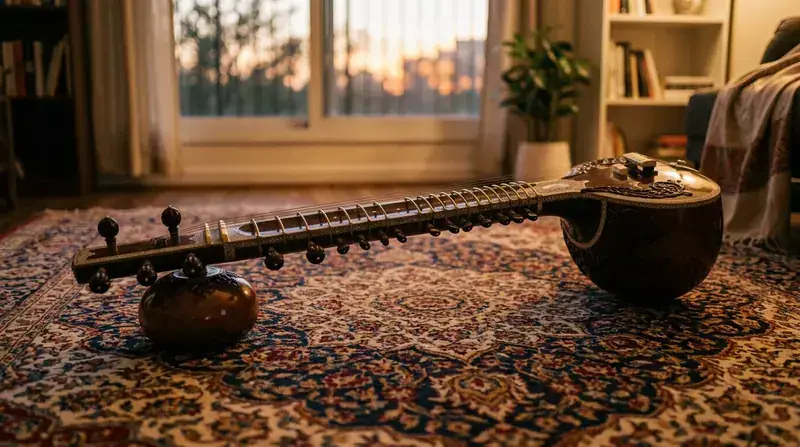
Sa, the tonic, and the drone. Every note in a raga is heard in relation to Sa, which is why a tanpura is not decoration but the reference that makes the tuning audible. Change the drone and the same finger positions become a different set of intervals; keep it steady and your ear starts to hear the relationships rather than the individual notes.
The second anchor is the vadi, the raga's most important note, and the one the phrases keep returning to. Listening for it is the fastest way into an unfamiliar raga: follow where the melody goes when it rests, and you have found the note the raga is organized around.
Why improvisation is the point
A jazz musician improvises over a chord progression. In Indian classical music, a performer improvises inside a raga and against a rhythmic cycle called a tala. There is no fixed chord progression to lean on — the structure is the raga's rules plus the tala's cycle. That is a lot of freedom, and it only works because the rules are learned deeply enough to be instinct.
A raga performance is largely made up in the moment within a strict grammar. That is not the same as free improvisation: the phrases, the order of the unfolding, the treatment of each note and the movement towards the upper register all follow conventions that a student learns by imitation over years.
For a beginner this is liberating once it clicks. You are not trying to reproduce a recording; you are learning a language well enough to say something of your own in it. The compositions are there to give you a shape, and the improvisation is where the raga actually lives.
How long before you can improvise in one?
Years. What arrives much sooner is real, audible progress: steady pitch, clean exercises, and the ability to perform a composed piece properly. The timing varies by student; regular lessons and consistent practice help build those skills.
Comfortable, simple improvisation in a small raga usually takes six to twelve months of regular practice with a teacher, and it arrives unevenly: a student may improvise fluently in one phrase and be lost in the next for another month. It also depends on the raga — some are far more forgiving than others, which is why teachers start with the small ones.
The honest marker is not time but hearing. Once you can tell when a phrase has resolved and when it has not, improvisation becomes possible, because you can hear what you are doing. Students who cannot yet hear that are not ready, whatever the calendar says.
Listen for the note a phrase returns to
A beginner can focus on where a phrase feels settled before trying to memorize every rule. Listen to a short example more than once and notice which note returns or receives a longer pause. A teacher can help name that musical role after the student has heard it.
- Choose one short example rather than a full performance.
- Hum the ending note softly after listening.
- Compare the phrase’s resting point with its other notes.
Play a recording of an unfamiliar raga and follow only one thing: where the melody comes to rest. Most phrases will settle on the same note or the same pair of notes. That is the raga's center of gravity, and once you have found it, the rest of the performance becomes legible.
Then listen for the notes that are never held, only passed through. Those are the ones that give the raga its character, and noticing them is a more useful exercise than trying to name the scale from a list.
Try a short phrase with a steady drone
A drone can provide a reference while you listen and sing a small phrase. Keep the phrase simple and focus on how the notes move around the tonal center. The purpose is attentive listening, not improvising freely before the sound and structure are familiar.
- Use a comfortable pitch and a quiet setting.
- Repeat a short phrase against the drone.
- Pause and describe which note feels most settled.
Related: Hindustani vocal lessons and Indian classical vocal.
Frequently asked questions
Is a raga the same thing as a scale?
No. A scale lists notes, while a raga also involves characteristic movement, emphasis, and phrases. A listener can begin with one short example and notice where the melody rests or turns. A teacher can explain the relevant rules gradually as the student learns to hear them.
How can a beginner start listening for a raga?
Choose a short recording and listen more than once. Notice a repeated phrase, the notes that feel settled, and how the melody moves around them. You do not need to identify the raga immediately; careful listening and a few questions make a useful starting point.
Do I need to improvise to learn about ragas?
No. Improvisation can be a later goal, but beginners can first learn to listen, repeat short phrases, and understand how a melody is shaped. A teacher can help build those skills step by step before asking the student to create a longer musical idea.
Next step
If you want to explore these listening ideas with a teacher, review the monthly lesson options or learn what happens in the free introductory session.